Ethical rules
The rules were last revised in March 2026. In this context, Gjensidige means the entire Gjensidige group.
1. Core values and transparency
Gjensidige’s mission is to safeguard lives, health and assets and to do so in a manner that takes the Group’s stakeholders into consideration.
A good business culture, sustainable choices and a positive reputation are fundamental preconditions for Gjensidige’s operations. In order to earn the trust of our customers and owners, the authorities and society at large, everything we do must be characterised by professionalism, expertise and high ethical standards. This applies to both the Group’s business operations and our employees’ conduct.
All Gjensidige’s activities must stand up to public scrutiny. Employees are expected to conduct themselves in accordance with the Group’s ethical rules. The ethical rules cannot always tell us what is right and wrong in any given situation. In cases of doubt, employees should raise the matter with their immediate superior or People.
The ethical rules apply to all Gjensidige employees, including those who are also officers of Gjensidige, as well as to hired consultants when acting on behalf of the Group.
2. Relationship to other regulations
The ethical rules set out requirements for ethical conduct, but it does not cover all aspects of what constitutes ‘correct’ behaviour. The Group has other guidelines and regulations that supplement the rules. It is important, therefore, to exercise judgement when the company considers what constitutes an ethically correct course of action in individual situations.
In addition to following the ethical rules, employees must loyally comply with laws, regulations, circulars, relevant codes of ethics for the industry and internal rules that regulate the Group’s activities. Managers must ensure that employees are given an opportunity to familiarise themselves with the regulations that apply to their work. However, it is the employees’ own responsibility to follow the rules.
3. Good business practice
3.1 Human rights and labour rights The Group shall support and respect fundamental human rights, including the UN Universal Declaration of Human Rights and the International Labour Organization (ILO). The Group’s financial investments shall comply with recognised principles for ethical investments from a human rights perspective.
3.2 The environment Gjensidige shall make systematic endeavours to reduce the business’s environmental impact on society and ensure that its employees, customers and partners can do the same. Gjensidige will apply the precautionary principle in its work for nature, climate and the environment.
We will therefore make active efforts to ensure that our employees, customers and partners contribute to reducing the environmental impact from their own operations. Gjensidige will give preference to solutions that help to reduce noise, lower energy and resource consumption and reduce emissions harmful to the climate and the environment. Environmental considerations will be taken into account throughout the production and distribution chain, and local, regional and global environmental factors must be addressed.
3.3 Healthy competition and sales The Group shall always act in accordance with relevant competition and marketing legislation. We will exercise due care in connection with work carried out under the auspices of industry associations, and where competitors are involved. Such work shall always be carried out within the scope of the remits and/or guidelines drawn up.
The Group must not engage in any form of sale or marketing that could be perceived as offensive. When advice is given, it must always be in accordance with good business practice that is based on the customers’ needs, financial situation and willingness to take risk, and the advice must serve the customers’ interests.
3.4 Conflicts of interest and good business practice Any risk of conflicts of interest arising shall be identified, minimised and dealt with, and customer service that is not compatible with the requirements for good business practice must be avoided. Particular attention must be paid to conflicts of interest and fairness in connection with statutory or essential insurance products, such as motor, property, liability and occupational injury insurance.
All identified conflicts of interest must be dealt with through prohibitions or measures and documented as required by the Group’s risk management and internal control system. If it is not possible to implement measures capable of eliminating the risk that a customer’s interests might suffer with reasonable certainty, then the customer shall be informed about the potential conflict of interest and about the measures implemented.
Potential conflicts of interest shall be assessed at the earliest possible time, and the company shall ensure that customer interests take precedence over the company’s interests and the personal interests of affected individuals. Individual customers shall not be unfairly favoured at the expense of other customers.
Particular attention must be paid to preventing the exclusion of vulnerable groups from taking part in the insurance collective. When setting the price of insurance products, price variables linked to vulnerable groups may only be used if the variables in question are legal and relevant to risk pricing.
Gjensidige will avoid methods that aim to maximise consumers’ financial willingness to pay or level of acceptance, or that entails discrimination.
Consumers who do not wish to share sensitive or private information shall not be discriminated against, and they shall be offered alternative products where appropriate. If it is strictly necessary for certain products to collect sensitive or private information, this must be communicated clearly to the consumer, and such information must be processed in accordance with the applicable regulations and with respect for data protection.
3.5 Tax Gjensidige must obey the relevant tax legislation in the countries where the Group operates. Gjensidige must inform the tax authorities about any transactions and dispositions where Gjensidige finds the law to be unclear. The Group shall not support or facilitate tax avoidance by other parties.
3.6 Corruption Corruption means abusing one’s position to obtain improper personal or business benefits for oneself or others. Through its anti-corruption programme, the Group shall make active endeavours to prevent corruption.
No one may accept benefits for themselves or on behalf of others from the Group’s business connections if such benefits are a result of their employment relationship. Correspondingly, no one may offer such benefits to business connections. Benefits can take the form of gifts, discounts, travel and bonuses in connection with private purchases, loans etc. This rule does not apply to benefits that the Group has negotiated for all employees in a country or parts of a country where the Group conducts business.
Employees must not let their decisions or actions be influenced by undue pressure or offers of financial benefits from parties with an interest in the matter.
3.7 Money laundering and terrorist financing ‘Money laundering’ means that the proceeds of crime are treated in a manner whereby their original source is concealed and the proceeds thus appear to be legitimate assets.
‘Terrorist financing’ means to obtain money or other assets for the purpose of financing acts of terrorism or the planning of or preparation for an act of terrorism.
Suspicions of money laundering or terrorist financing must be reported. See the section on whistleblowing.
3.8 Responsible development and use of artificial intelligence Gjensidige is committed to developing and using artificial intelligence in a responsible and ethical manner in line with the Group’s values, applicable regulations and human rights. Artificial intelligence shall not be developed or used for purposes prohibited under the AI Act. Gjensidige shall take a proportional and risk-based approach to transparency and explainability when using automated decision-making and advanced technology such as AI. Gjensidige shall practice transparency and explainability as required by law and otherwise in cases with significant impact on affected parties or the Group.
3.9 Management of employee data Gjensidige shall protect the integrity and trust of its employees in all use of digital traces and data. We will not use data concerning employees’ use of digital tools to measure productivity or efficiency at individual or group level unless such use is explicitly based on an agreement entered into with trade unions and a thorough assessment of its ethical and legal consequences. Any processing of such data must take place in accordance with the applicable data protection legislation and with respect for individuals’ right to privacy. Systems and services may be monitored for company security purposes, but the extent of such monitoring must be limited to what is necessary and proportionate.
4. Personal conduct
4.1 Inclusion and respect All Gjensidige employees share a responsibility to promote a culture characterised by inclusion and mutual respect. Employees must conduct themselves with common courtesy in a manner that is respectful and considerate. By being inclusive and committed, we make each other better. There must be no discrimination or harassment. Anyone who feels that they are being discriminated against or harassed shall be taken seriously.
4.2 Relations with managers and colleagues Gjensidige aims to create a diverse, positive, stimulating and enthusiastic working environment. Standards for behaviour shall be guided by our values: we take responsibility, we create learning and we build trust. All Gjensidige’s employees have a responsibility for helping to create a good working environment.
4.3 Duty of secrecy Employees have a duty of secrecy in relation to business matters and matters of a private nature that they become aware of in connection with the performance of their work for the Group. This duty applies unless they are legally obliged to disclose such information or are obliged or urged to report such matters pursuant to these ethical rules. The employees’ duty of secrecy does not only apply in relation to third parties, but also between the companies in the Group.
The duty of secrecy applies in relation to colleagues, advisers, family members and others, unless the party entitled to confidentiality has expressly consented to the exchange of information. Employees shall not seek information about other employees or customers unless they need the information in the course of their work.
Employees’ duty of secrecy applies in full even when they work from home. Employees must exercise particular caution in handling confidential information when working outside their primary workplace.
The duty of secrecy continues to apply after employees leave Gjensidige.
4.4 Relations with business connections No one may act in a way that could prevent them from being impartial in relation to the Group’s customers, suppliers, shareholders or other business connections. Employees must exercise caution when entering into private agreements and exchanging services with companies and persons with whom they have dealings through their work for the Group. They must also exercise caution in relation to business agreements with persons with whom they have a personal relationship.
Employees who have a personal relationship with a business connection must notify their immediate superior for clarification.
4.5 Hospitality and events Employees who represent the Group as part of their professional role must behave responsibly and in a manner that helps to maintain trust in the Group as well as in the individual employee in question.
Events organised by the Group shall be characterised by moderation and have relevant professional content. If alcohol is to be served at an internal Gjensidige event, this will be limited to beer and wine, and non-alcoholic options must always be available. If spirits are permitted to be served at an event, the participants must pay for them themselves.
Any costs of travel and overnight stays for external participants in connection with an event must be covered by the participants themselves (either directly or in the form of a participation fee).
Employees who are considering participating in trips or events under the auspices of Gjensidige’s business connections must obtain their immediate superior’s approval in advance. Travel and accommodation in connection with the performance of work for Gjensidige shall, as a rule, be covered by the Group. Any deviation from this rule must be cleared with the employee’s immediate superior. This also applies to travel and accommodation in connection with seminars and other job-related events that are covered directly or as part of the participation fee. All employees shall comply with the national procedures for welfare measures, seminars, gifts and rewards for own employees, as well as for customer relations.
Sponsor activities must be in accordance with Gjensidige’s sponsorship strategy.
Gjensidige has prohibited political donations, and full transparency is required about all payments that could be perceived as support for an organisation.
4.6 Gifts and benefits Employees or their closely related parties may not accept or offer gifts or other benefits, including discounts or bonuses in connection with private purchases, from or to customers, sponsors or suppliers that could be related to the employee’s employment relationship with the Gjensidige Group.
This rule does not apply to benefits that the Group has negotiated for all employees. Employees may also receive gifts of limited value from external parties on special occasions. These gifts must be registered in the gift and relations register and cannot exceed a value of NOK 600 (in local currency) per party per year. If there is a risk that an employee’s impartiality or independence can be called into question, the gift must not be accepted. If gifts are returned, this should be done in a manner that causes as little offence as possible.
Employees must not accept gifts or services of any kind in connection with or prior to entering into negotiations or in return for entering into business agreements on behalf of Gjensidige.
Corresponding restrictions apply when giving gifts to business connections. Gjensidige’s motives and the integrity of the recipient must be beyond question.
4.7 Family relations As a rule, closely related parties, such as siblings, parents/children or spouses/cohabitants/partners, shall not work under the same EVP. Exemptions can be made from this rule based on a concrete assessment that takes into consideration the size and complexity of the division, among other things. The assessment is to be carried out by People, and such situations must always be clarified in advance. Closely related parties shall not obstruct, assess, approve, audit, check or in other way influence each other’s work.
4.8 Impartiality No one may participate in or influence the consideration of or decision in a matter when circumstances exist that could weaken trust in their independence.
No one may consider, decide or seek to influence a matter if they themselves or any of their closely related parties have any direct or indirect financial or other personal interests in the matter. By closely related parties is meant a person’s spouse, partner, cohabitant and children, as well as any companies, associations, clubs etc. in which the employee or any of their closely related parties have significant influence. Other personal relations may also by their nature be considered equivalent to closely related parties (for example neighbours or close friends).
As a rule, if a superior is deemed to be disqualified on grounds of partiality, the matter in question cannot be decided by anyone reporting directly to them.
Employees shall inform their immediate superior as soon as they become aware that a conflict related to impartiality may arise. The superior shall consider the risk of the employee’s impartiality or ethical integrity being called into question by other employees or external parties. If there is such a risk, the employee in question must not participate in further consideration of the matter.
Employees must not use their position to influence appointments so that preference is given to a candidate on the basis of criteria other than those that are directly relevant for the position in question.
4.9 External communication and social media Only the CEO, CFO, the IR department, the head of Gjensidige Denmark, the head of Gjensidige Sweden and the head of Gjensidige Pensjonsforsikring may, in consultation with the communications department, make public statements regarding the Group’s financial position. Other employees must ensure that messages containing financial information have been approved by IR and are based on other publicly available information published in quarterly presentations and reports, analysts and capital markets days, the annual report or other information made available to the general public via gjensidige.com. No previous authorisation is required for repeating financial messages from press releases issued in connection with quarterly reporting on social media, but nonetheless, everyone must exercise caution to avoid giving rise to other interpretations of the message than intended in the press release.
Employees must always be aware that they could be perceived as representing Gjensidige, even in their private use of social media. Communication must not be detrimental to the Group’s reputation or business interests or in breach of data protection legislation.
4.10 Secondary jobs and offices and assignments for other companies and organisations No employee may, without the written consent of their employer, work for, serve on the board of, operate or have financial interests in undertakings that engage in the same type of business as one of the Group’s companies or that have business relations with such companies.
If a permanent employee of the Group wishes to start a private business or take paid employment during their free time, they must clear this with their immediate superior and/or People in advance. If the secondary job/office can be combined with fully satisfactory work performance and their position in the Group, the employee may be granted permission. Managers must be informed about political offices, which are regulated by law, and arrangements must be made to minimise any inconvenience to the Group.
Employees must inform their immediate superior if they or any of their closely related parties have ownership interests in businesses with which Gjensidige has a customer or supplier relationship. If there is a risk that such ownership interests could give rise to doubt concerning the employee’s loyalty or independence, Gjensidige may demand that the ownership or customer relationship be terminated and set a deadline for its termination.
Unless express written permission has been obtained from their immediate superior, an employee in an executive position may not be a board member or member with other responsibilities in a company engaged in business activities. Other employees may hold offices outside Gjensidige. If an employee is in doubt about whether such an engagement will affect their work for the Group or is in conflict with the Group’s guidelines, they must raise the matter with their immediate superior. In cases where the company’s employees refer to Gjensidige in the media, the Group expects a courteous and loyal attitude.
4.11 Insider information and security trading Insider information is specific information that has not been made public, that an investor is likely to use as the basis for investment decisions, and that could influence the price of the Gjensidige share upwards or downwards. No employee may use or assist others in using insider information about the Group or other companies as a basis for trading in securities. This applies to both private trading and trading on behalf of the Group.
Private investments in securities must be kept within responsible financial limits to avoid finding oneself in situations where one could be vulnerable to strong financial pressure. Gjensidige’s interests shall always take precedence over employees’ personal interests, and such interests must be kept separate.
Any doubts concerning potential insider information and securities trading must be raised with the CFO or Head of Investor Relations in advance of any trading.
Board members are referred to the rules on impartiality and the duty of secrecy (see the Financial Undertakings Act Sections 9-5 and 9-6).
4.12 Use of the Group’s equipment and property The Group’s IT equipment is work tools that are primarily to be used for their intended purpose. No one may use the company’s data, IT equipment, material or other property for activities that are illegal or that may be perceived as unethical and/or offensive. Each employee has an independent responsibility for all activities they carry out using their user account and the IT equipment assigned to them.
4.13 Orderly personal finances and financial situation Gjensidige expects employees to have their personal finances in order. Employees who take up positions that confer powers to commit Gjensidige financially must expect Gjensidige to conduct a credit check.
The Group expects employees to ensure that their financial obligations in relation to Gjensidige are in order, and this includes customer relationships with the company.
If an employee is under strong financial pressure, that could be construed as weakening the respect and independence of the Group. Employees who realise that they will be unable to meet their financial obligations must inform their immediate superior, unless the financial situation is of a temporary nature.
Employees must not register or change the terms and conditions of their own or their closely related parties’ insurance contracts or other agreements. However, this does not prevent employees from using the service channels that are open to other customers.
If an employee’s insurance claim or attempt to take out insurance is rejected on grounds of insurance fraud, this may have consequences for their employment relationship. The same applies in the event of other dishonest conduct as a customer in any other of the Group’s business areas. As customers of their own company, employees must conduct themselves in the same way as other customers in their communication with the company. Internal communication channels or undue pressure must not be used.
Coverage of an employee’s work-related expenses must be approved by their superior in accordance with applicable authorisations.
Fringe benefits enjoyed by Gjensidige’s employees must not be used for purposes other than those forming the basis for the arrangement.
Participation in illegal gambling that entails financial risk is not compatible with Gjensidige’s activities.
4.14 Human dignity Employees on service assignments or business travel must not behave in a manner that could violate other people’s human dignity. This means, among other things, that employees must not purchase sexual services.
4.15 Self-interest Employees must not behave in a way that could secure undue enrichment or benefits for themselves.
Employees who leave the Group may not take with them or copy the company’s knowledge base, customer lists, internal systems or other organised forms of knowledge. Nor may they take with them rights or intellectual property that have been purchased or developed by employees or others for the Group. Immediate superiors have a particular responsibility for following this up.
4.16 Dependency Dependency refers to employees having issues or problems relating to, for example, alcohol, narcotic substances, abuse of medication, doping, pornography, compulsive shopping, computer gaming and/or gambling. The immediate superior is responsible for raising the issue with the employee in question, and People will assist by putting in place relevant measures to help them.
Alcohol consumption must not interfere with subsequent work performance.
5. Whistleblowing
Whistleblowing means to report censurable conditions in the workplace. By censurable conditions is meant matters that are in breach of
- laws and regulations (legal rules)
- the company’s written ethical rules
- ethical standards widely accepted by society
There is a duty to report certain cases, and this duty applies
- when a co-worker is subjected to discrimination or harassment
- to matters that may entail a risk to life or health
- when the duty is set out in other legislation, such as health legislation or the Money Laundering Act
- when the duty is set out in regulations, instructions or rules applicable to the duties or to Gjensidige in general
Gjensidige encourages employees to report censurable conditions to enable swift rectification. There are several ways of reporting such matters, but you can always notify your immediate superior or use the whistleblowing channels.
6. Responsibility and follow up
Managers at all levels have a particular responsibility for ensuring that their own and their subordinates’ conduct is in compliance with the regulations. Line managers are responsible for making the Code of Conduct known, as well as for following up employees to ensure that they comply with it.
People has overriding responsibility for managing the ethical rules, including for following up the gift register and the ethics mailbox. People is charged with helping the management to ensure that all employees are made aware of how to apply the rules in their day-to-day work. People is also to inform relevant second-line and third-line functions about matters of relevance to the performance of their duties. Breaches of the ethical rules will be dealt with in accordance with the policy for operational incident management.
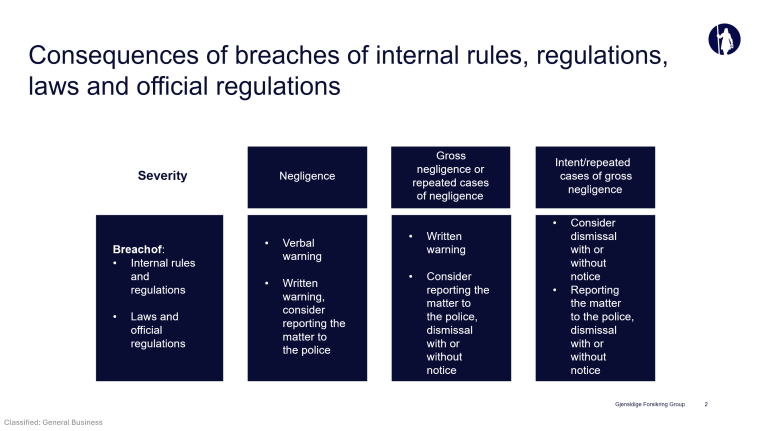
The consequences of breaches of internal rules, guidelines, laws and official regulations will vary depending on the severity of the breach. See the table below.